Valid Braindumps JN0-683 Files - JN0-683 Downloadable PDF
Wiki Article
What's more, part of that Fast2test JN0-683 dumps now are free: https://drive.google.com/open?id=1yu578MMTfxUVbXthf4-Pi2FOu0IUN7TU
In order to meet the needs of all customers, our company employed a lot of leading experts and professors in the field. These experts and professors have designed our JN0-683 exam questions with a high quality for our customers. We can promise that our products will be suitable for all people. As long as you buy our JN0-683 practice materials and take it seriously consideration, we can promise that you will pass your exam and get your certification in a short time. So choose our JN0-683 exam questions to help you review, you will benefit a lot from our JN0-683 study guide.
The JN0-683 mock tests are specially built for you to evaluate what you have studied. These Data Center, Professional (JNCIP-DC) (JN0-683) practice exams (desktop and web-based) are customizable, which means that you can change the time and questions according to your needs. Our JN0-683 Practice Tests teach you time management so you can pass the Data Center, Professional (JNCIP-DC) (JN0-683) certification exam.
>> Valid Braindumps JN0-683 Files <<
JN0-683 Simulated Study Material & JN0-683 Vce Training File & JN0-683 Valid Test Questions
Many candidates compliment that Juniper JN0-683 study guide materials are best assistant and useful for qualification exams, they have no need to purchase other training courses or books to study, and only by practicing our Juniper JN0-683 Exam Braindumps several times before exam, they can pass exam in short time easily.
Juniper JN0-683 Exam Syllabus Topics:
| Topic | Details |
|---|---|
| Topic 1 |
|
| Topic 2 |
|
| Topic 3 |
|
| Topic 4 |
|
Juniper Data Center, Professional (JNCIP-DC) Sample Questions (Q11-Q16):
NEW QUESTION # 11
Exhibit.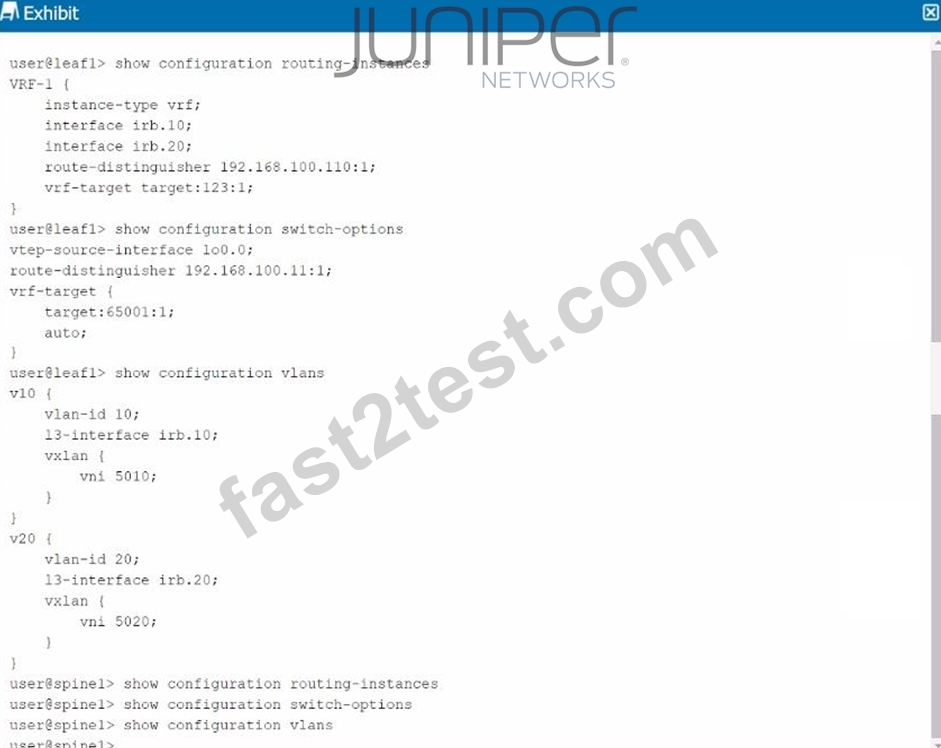
Referring to the exhibit, which statement Is true?
- A. A CRB architecture is being used.
- B. A PBB-EVPN architecture is being used.
- C. An OTT architecture is being used.
- D. An ERB architecture is being used.
Answer: D
Explanation:
* Understanding Network Architectures:
* ERB (Edge Routed Bridging) architecture involves routing at the network's edge (leaf nodes), while traffic between leaf nodes is switched. This is commonly used in VXLAN-EVPN setups.
* Analysis of the Exhibit:
* The exhibit shows configurations related to routing instances, VXLAN, and VLANs, with VNIs being used for each VLAN. This setup is characteristic of an ERB architecture where each leaf device handles Layer 3 routing for its connected devices.
Conclusion:
* Option B:Correct-The configuration shown corresponds to an ERB architecture where routing occurs at the network's edge (leaf devices).
NEW QUESTION # 12
You are deploying a new network lo support your Al workloads on devices that support at least 400 Gbps Ethernet. There is no requirement for any Layer 2 VLANs in this network. Which network architecture would satisfy this requirement?
- A. an IP fabric with an EVPN-VXLAN architecture
- B. an IP fabric using PIM-SM to signal VXLAN overlay
- C. an IP fabric using the EVPN-MPLS architecture
- D. an IP fabric using EBGP
Answer: D
Explanation:
* Requirements for AI Workloads:
* The scenario requires a network that supports at least 400 Gbps Ethernet and does not require Layer 2 VLANs. This setup is well-suited for a pure Layer 3 network, which can efficiently route traffic between devices without the overhead or complexity of maintaining Layer 2 domains.
* Choosing the Right Network Architecture:
* Option D:An IP fabric using EBGP (External BGP) is ideal for this scenario. In a typical IP fabric, EBGP is used to handle routing between spine and leaf switches, creating a scalable and efficient network. Since there is no need for Layer 2 VLANs, the pure IP fabric design with EBGP provides a straightforward and effective solution.
* Options A, B, and Cinvolve more complex architectures (like VXLAN or EVPN), which are unnecessary when there's no requirement for Layer 2 overlays or VLANs.
Conclusion:
* Option D:Correct-An IP fabric with EBGP is the most suitable and straightforward architecture for a network that needs to support high-speed AI workloads without Layer 2 VLANs.
NEW QUESTION # 13
Exhibit.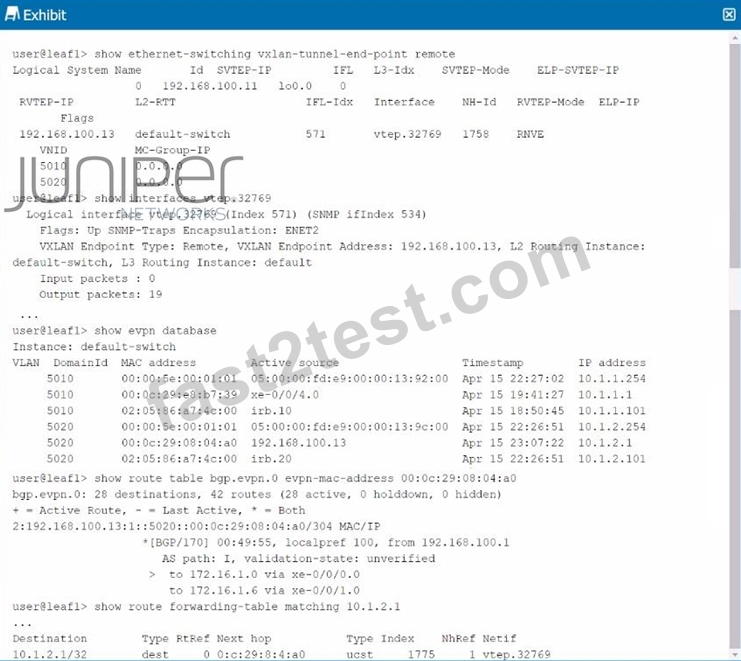
Referring to the exhibit, Host1 (10.1.1.1) is failing to communicate with Host2 (10.1.2.1) in a data center that uses an ERB architecture. What do you determine from the output?
- A. Host1 and Host2 are directly connected to leaf1.
- B. The traffic is entering the VXLAN tunnel.
- C. The traffic is failing because load balancing is not configured correctly.
- D. The irb.20 interface is not configured on leaf1.
Answer: B
Explanation:
Understanding the Problem:
* Host1 (10.1.1.1) is failing to communicate with Host2 (10.1.2.1) within an EVPN-VXLAN environment using ERB architecture.
Analysis of the Exhibit:
* The provided output includes information from the show route forwarding-table matching command for IP 10.1.2.1. The next hop is shown as vtep.32769, which indicates that the traffic destined for 10.1.2.1 is being forwarded into the VXLAN tunnel with the correct VTEP (VXLAN Tunnel Endpoint).
Conclusion:
* Option B:Correct-The traffic from Host1 is entering the VXLAN tunnel, as evidenced by the next hop pointing to a VTEP. However, the issue could lie elsewhere, possibly with the remote VTEP, routing configurations, or the receiving leaf/spine devices.
NEW QUESTION # 14
Exhibit.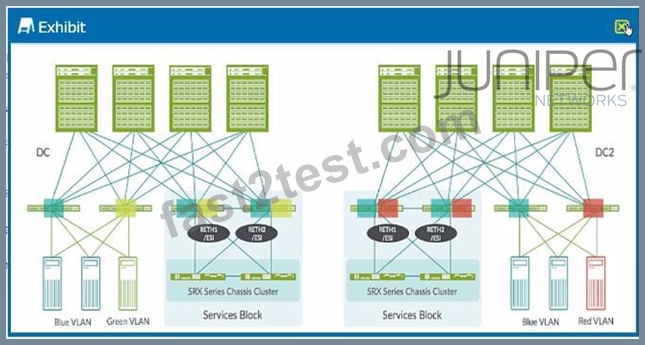
Both DC and DC2 ate using EVPN-VXLAN technology deployed using an ERB architecture. A server on the Red VLAN must communicate with a server on the Green VLAN. The Blue VLAN in DC and DC2 needs to be the same VLAN.
Which statement is correct in this scenario?
- A. A lean super spine device must be added to DC and DC2; all VLANs must be stretched to the lean super spine device and the lean super spine devices must stitch all the VLANs together.
- B. An interconnect is required between the four SRX Series devices; the Blue VLAN must be stretched and a transit VNI must be added for the Red and Green VLANs.
- C. An interconnect is required between four leaf devices in the services blocks; the Red VLAN and the Green VLAN must be stitched and the Blue VLAN must be stretched.
- D. The eight spine devices must be configured as border spine devices; a full mush interconnect must exist between all eight spine devices and the Blue VLAN must be stitched together
Answer: B
Explanation:
* ERB Architecture in EVPN-VXLAN:
* ERB (Edge Routed Bridging) architecture is commonly used in data center networks where routing decisions are made at the network edge (leaf or border devices), while bridging (Layer 2 forwarding) is extended across the fabric. This architecture allows for efficient L3 routing while still enabling L2 services like VLANs to span across multiple locations.
* VLAN and VNI Configuration:
* The scenario specifies that a server on the Red VLAN needs to communicate with a server on the Green VLAN. Since these VLANs are in different data centers (DC and DC2), and given the use of EVPN-VXLAN, the communication between these VLANs will require atransit VNI(Virtual Network Identifier). This transit VNI will allow traffic to traverse the VXLAN tunnel across the DCI (Data Center Interconnect).
* Interconnect between SRX Series Devices:
* The exhibit shows SRX Series Chassis Clusters used as service devices (likely for firewalling or other security services). These devices need to be interconnected between the two data centers to ensure that VLANs can communicate effectively. The Blue VLAN needs to be stretched between DC and DC2 to maintain the same Layer 2 domain across both data centers.
Conclusion:
* Option B:Correct-Interconnecting the SRX Series devices will ensure the necessary service chaining, while stretching the Blue VLAN and adding a transit VNI for the Red and Green VLANs will enable the required communication across the data centers.
NEW QUESTION # 15
Referring to the exhibit, which statement is correct?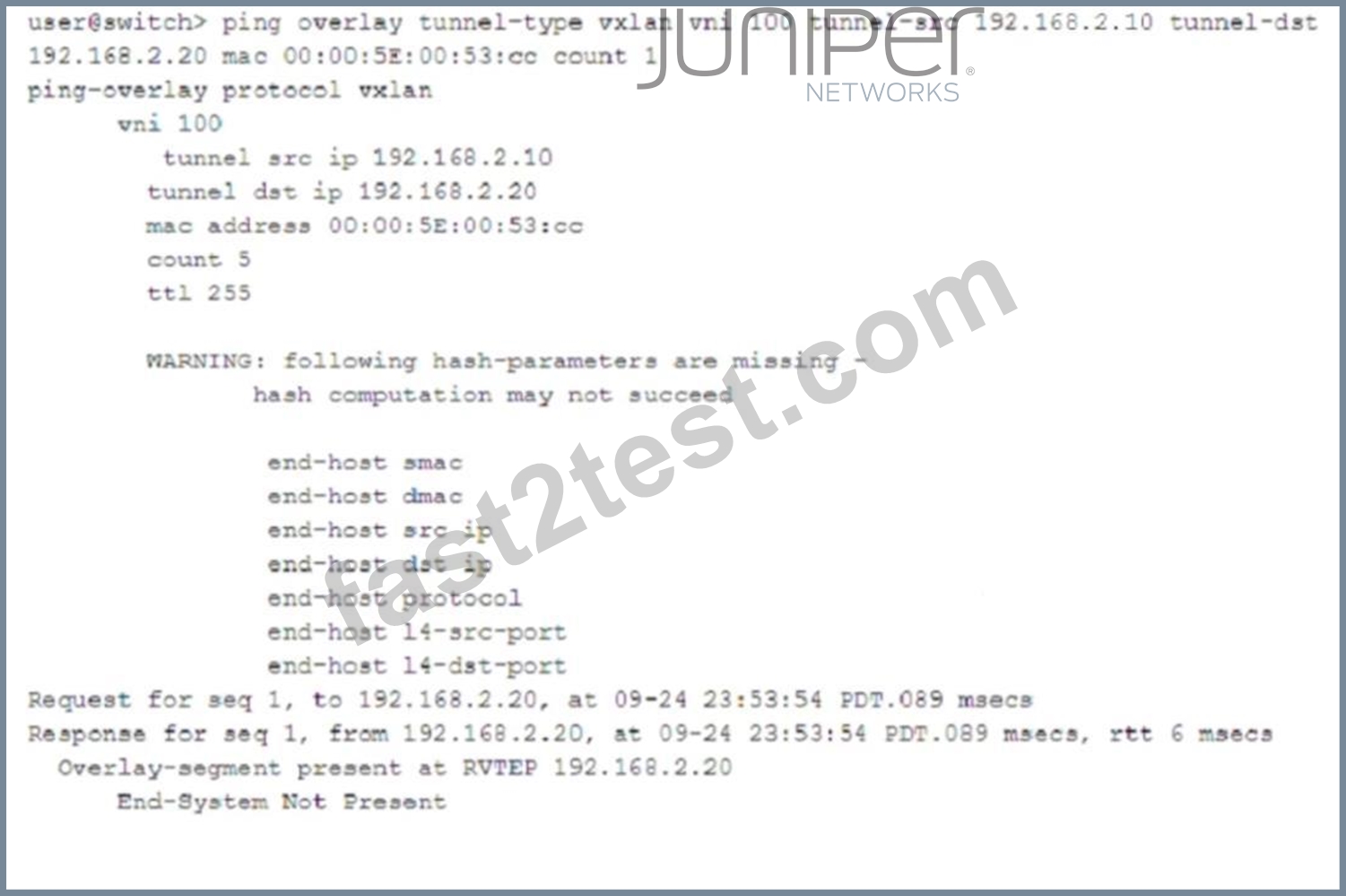
- A. The remote VTEP is not responding.
- B. The MAC address is unknown and not in the forwarding table of the remote VTEP.
- C. The MAC address is known but not reachable by the remote VTEP.
- D. VNI 100 is not configured on the remote VTEP.
Answer: B
Explanation:
The output shows a VXLAN ping test using ping overlayto verify VXLAN reachability between VTEPs (Virtual Tunnel Endpoints). The test successfully reaches the remote VTEP
192.168.2.20, meaning the VXLAN tunnel is functional. However, the response indicates "End- System Not Present," which means that while the VXLAN segment is active on the remote VTEP, the specified MAC address (00:00:5E:00:53:CC) is not known in the forwarding table of the remote VTEP.
NEW QUESTION # 16
......
Our JN0-683 practice engine boosts both the high passing rate which is about 98%-100% and the high hit rate to have few difficulties to pass the test. Our JN0-683 exam simulation is compiled based on the resources from the authorized experts’ diligent working and the real exam and confer to the past years’ exam papers thus they are very practical. So the content of the JN0-683 Learning Materials is quite fully covered and completed. And we will update it to be the latest.
JN0-683 Downloadable PDF: https://www.fast2test.com/JN0-683-premium-file.html
- Pass-Sure Juniper Valid Braindumps JN0-683 Files Are Leading Materials - 100% Pass-Rate JN0-683: Data Center, Professional (JNCIP-DC) ???? Easily obtain ☀ JN0-683 ️☀️ for free download through ( www.troytecdumps.com ) ????JN0-683 New Exam Bootcamp
- JN0-683 Dump Torrent ???? JN0-683 Dump Torrent ???? JN0-683 Guide Torrent ⛅ Go to website 【 www.pdfvce.com 】 open and search for ▷ JN0-683 ◁ to download for free ????JN0-683 Exam Question
- Juniper JN0-683 the latest exam questions and answers free download ???? Search for ➤ JN0-683 ⮘ and download it for free immediately on ▶ www.prep4away.com ◀ ????JN0-683 Exam Question
- Valid JN0-683 Exam Topics ???? Exam JN0-683 Guide Materials ???? Valid JN0-683 Study Materials ⭐ Go to website ▶ www.pdfvce.com ◀ open and search for ➠ JN0-683 ???? to download for free ????Pass Leader JN0-683 Dumps
- Quiz 2026 Juniper The Best Valid Braindumps JN0-683 Files ???? ▛ www.torrentvce.com ▟ is best website to obtain ➽ JN0-683 ???? for free download ????Reliable JN0-683 Test Notes
- Exam JN0-683 Guide Materials ???? Test JN0-683 Collection ???? Valid JN0-683 Study Materials ???? Download 【 JN0-683 】 for free by simply searching on ➠ www.pdfvce.com ???? ????JN0-683 New Exam Bootcamp
- Examcollection JN0-683 Questions Answers ???? Reliable JN0-683 Test Notes ???? Trustworthy JN0-683 Exam Content ???? Open website ▶ www.examcollectionpass.com ◀ and search for 《 JN0-683 》 for free download ????Valid Study JN0-683 Questions
- JN0-683 Dump Torrent ???? Test JN0-683 Collection Pdf ???? JN0-683 New Exam Bootcamp ???? Easily obtain ➤ JN0-683 ⮘ for free download through ➥ www.pdfvce.com ???? ????Test JN0-683 Collection
- 100% Pass 2026 Juniper JN0-683 –Reliable Valid Braindumps Files ???? Easily obtain free download of ( JN0-683 ) by searching on ⇛ www.troytecdumps.com ⇚ ⚒Pass Leader JN0-683 Dumps
- Free PDF 2026 Juniper Updated Valid Braindumps JN0-683 Files ???? Download { JN0-683 } for free by simply searching on ▶ www.pdfvce.com ◀ ????Latest JN0-683 Test Report
- 100% Pass 2026 Juniper JN0-683 –Reliable Valid Braindumps Files ???? ➽ www.pass4test.com ???? is best website to obtain ( JN0-683 ) for free download ????JN0-683 Dump Torrent
- royalbookmarking.com, www.stes.tyc.edu.tw, macieryug000496.life3dblog.com, madbookmarks.com, jaspervceq119831.answerblogs.com, naturalbookmarks.com, tutor.aandbmake3.courses, hamzaszmc332285.blogthisbiz.com, www.stes.tyc.edu.tw, lilyfugh386350.blogdeazar.com, Disposable vapes
BTW, DOWNLOAD part of Fast2test JN0-683 dumps from Cloud Storage: https://drive.google.com/open?id=1yu578MMTfxUVbXthf4-Pi2FOu0IUN7TU
Report this wiki page